

- Analog Multimeter Definition: An analog multimeter is a device used to measure electrical quantities like voltage, current, and resistance using a needle and scale.
- Working Principle: It works on the d’Arsonval galvanometer principle, where a coil in a magnetic field moves to indicate measurements.
- Analog Multimeter Diagram: The diagram shows switches to select measurement types and ranges, plus a rectifier for AC measurements.
- Advantages: Analog multimeters detect sudden signal changes faster and can measure various quantities with one device.
- Disadvantages: They are bulky, slow, less accurate due to the earth’s magnetic field, and sensitive to shock and vibration.
Multimeters, as the name suggests, are instruments used to measure multiple electrical quantities. The most basic analog multimeter measures voltage, current and resistance, often referred to as an AVO meter (Amperes, Volts, Ohms). There are two types of multimeters: analog and digital multimeter. This article focuses on analog multimeters.
An analog multimeter is a PMMC (permanent-magnet moving-coil) meter with a needle on a printed scale. Digital meters have taken most field work. Analog still helps when you want to watch a trend rather than a digit step.
It works on the d’Arsonval galvanometer principle. A needle indicates the measured value on a scale. When current passes through a coil in a magnetic field, it creates a deflecting torque that moves the needle over a graduated scale.
A pair of hairsprings is attached to the moving spindle to provide the controlling torque. In a multimeter, the galvanometer is a left-zero instrument for volts and amps, i.e. the needle rests at the extreme left where that scale begins at zero. Ohms scales are often reversed.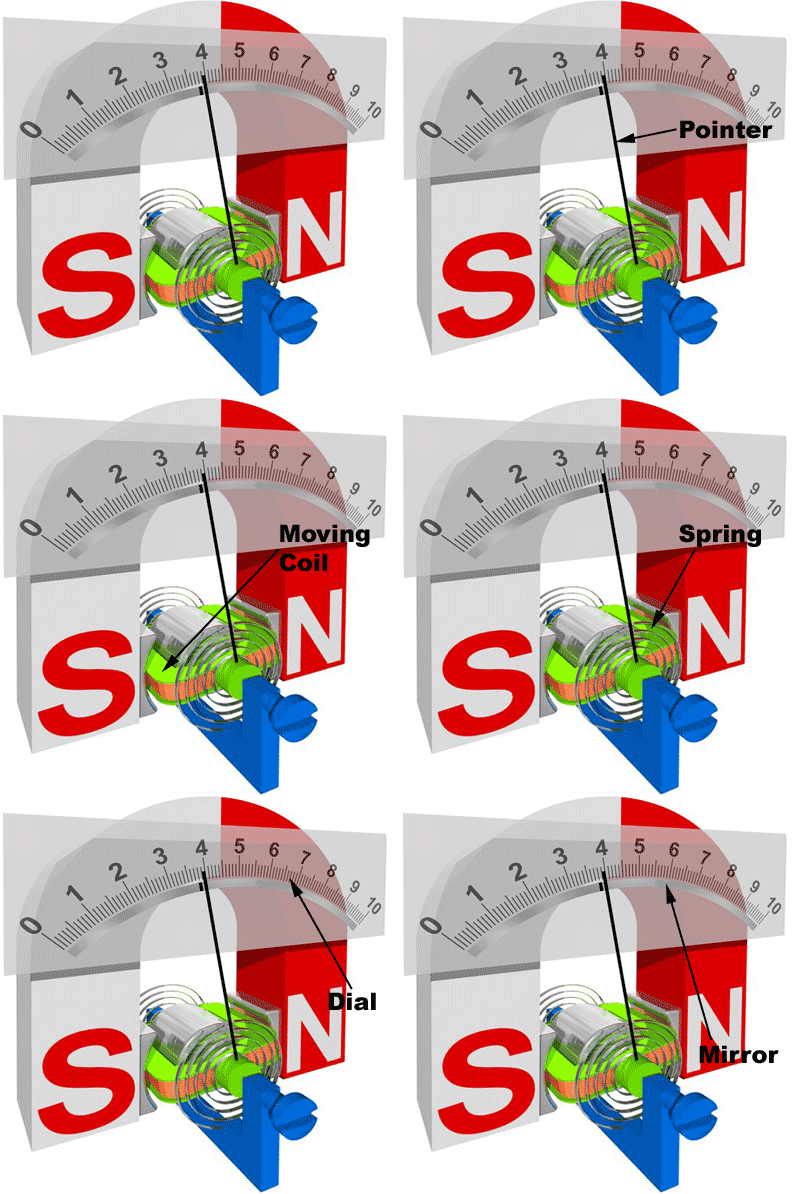
The meter functions as an ammeter with low series resistance for direct current. To measure high current, a shunt resistor is connected across the galvanometer, so only a known fraction of the current goes through the movement. This allows the multimeter to measure milli-amperes to amperes by bypassing most current through the shunt.
For DC voltage measurement, the primary instrument becomes a DC voltage measuring apparatus or DC voltmeter.
By adding a multiplier resistance, an analog multimeter can measure the voltage from milli-volts to kilovolts, and this meter works as a millivoltmeter, a voltmeter or even as a kilo voltmeter.
With a battery and a resistance network, the multimeter functions as an ohmmeter. The range can be changed by connecting a switch to different shunt resistances, allowing for various resistance measurement scales. Below is a basic block diagram of an analog multimeter.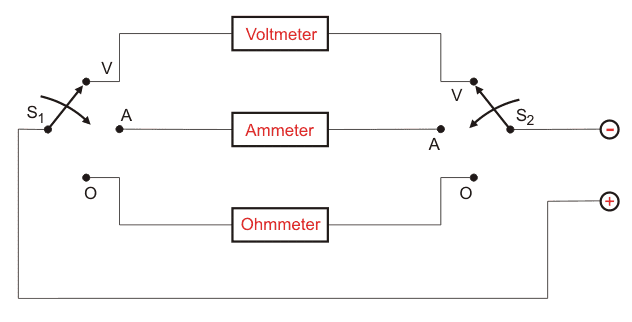
Here two switches S1 and S2 select the function. Extra range-selector switches pick the ampere, volt and ohm range. A rectifier lets the movement read AC voltage or current. That rectifier is usually average-responding and is scaled for a sine wave.
Advantages of Analog Multimeter
- A sudden change in signal can be seen on the needle more swiftly than on many digital multimeter displays that step in counts.
- All measurements are possible by using one meter only.
- An increase or decrease in signal levels can be observed.
Disadvantages of Analog Multimeter
- Analog meters are bulky in size.
- They can be costly for the accuracy they give.
- The pointer movement is slow
- A poorly shielded movement can pick up stray magnetic field, including the earth’s field. Loading and parallax are usually larger errors.
- They are vulnerable to shock and vibration.


