- Vector Algebra Definition: Vector algebra is the branch of mathematics dealing with vectors, quantities that have both magnitude and direction.
- Vector Diagrams: Vector diagrams are visual tools that show the magnitude and direction of vectors, aiding in understanding their relationships.
- Vector Components: A vector can be split into two perpendicular components, typically along the x and y axes.
- Complex Representation: Vectors can be represented using complex numbers, where the imaginary unit ‘j’ indicates a 90-degree rotation.
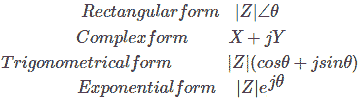
- Forms of Vectors: Vectors can be represented in different forms: rectangular, complex, trigonometric, and exponential.
AC electrical engineering needs the angle between voltage and current. That angle is handled with vector algebra and a vector diagram.
Definition of Vector
Some quantities have both size and a direction of action. Those quantities are called vectors. The short definition of vector is a quantity that carries magnitude and direction together. A force of 5 N is incomplete until the direction is named.
State whether that 5 N acts up, down or along some other line. The direction is the angle from a chosen reference axis to the line of action.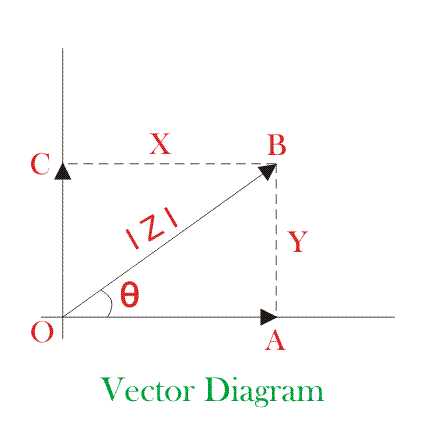
In this vector diagram, vector OB has magnitude |Z| at angle θ to the reference axis OX. It splits into two perpendicular components.

That is the usual written form of a vector.

Vector Algebra
Now treat the same idea as vector algebra. Calculation needs an algebraic form. In the vector diagram, Z is the sum of components X and Y.
In vector algebra that sum is written 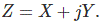
The j marks Y as perpendicular to X. On the vector diagram the x axis is the real or in-phase axis and the y axis is the imaginary or quadrature axis. The same j on Y is an operator that rotates a vector 90o anticlockwise. Rotate 180o anticlockwise and j acts twice, so the vector reverses and j.j or j2 = − 1
| Which implies, j = √ | − 1 |
The same vector can therefore be written in more than one form: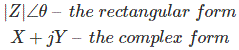
Relation between rectangular and complex form of a vector
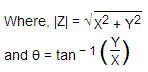
From the vector diagram on this page the magnitude of Z is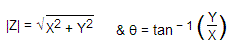
Those two equations give
Substitute X and Y into the complex form of Z:
That last line is the trigonometric form. The same cosθ and sinθ also have exponential forms
Put those into Z = |Z|(cosθ + jsinθ):
⇒ Z = |Z|ejθ
That is the exponential form.
So the vector algebra and vector diagrams on this page give four written forms: