

- Electric Field Definition: An electric field is defined as the region around a charged object where other charges experience a force.
- Electric Field Strength: Measures the force exerted on a unit positive charge within the field.
- Direction of Electric Field: Determined by the movement of a unit positive charge in response to the field’s force.
- Applications of Electric Fields: Used in various technologies like motors, antennas, and power lines.
- History of Electric Fields: Developed through the work of scientists like Michael Faraday and James Clerk Maxwell.
An electric field is defined as the region surrounding an electrically charged object. Within this field, any other charged objects will experience an electromagnetic force.
Electric field strength, also known as electric field intensity, measures the magnitude of this field. This can be observed by placing a unit positive charge in the vicinity of a charged object.
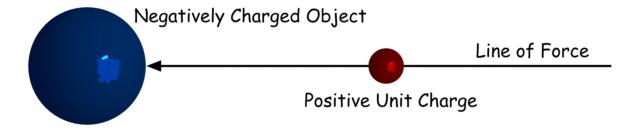
If the object is positively charged, the unit charge experiences a repulsive force, pushing it away from the object. The imaginary path along which this unit positive charge moves is referred to as the line of force.

In the field of a negative source charge, a positive test charge experiences a force towards the source. An electric field line points in that same direction at each point, but it is a visual representation of the field rather than necessarily the path of a moving particle.
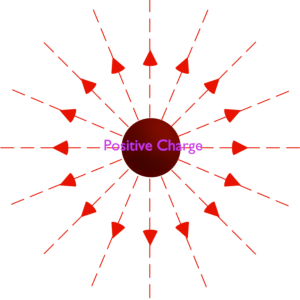
A positive source charge repels a positive test charge, so the electric field points radially away from the source. This direction convention does not describe the flow of current in a circuit. A field line is drawn tangent to the electric field vector at every point.
A negative source charge attracts a positive test charge, so its field points radially towards the source. Electric field also relates to voltage: the field points in the direction of decreasing electric potential.
The field line indicates the local force direction for a positive test charge. The actual trajectory can differ because it also depends on the particle’s mass, initial velocity and other forces.

Quantifying the Electric Field
Electric field strength at a point is the electric force per unit positive test charge, E = F/q. Its common units are newtons per coulomb (N/C) and the equivalent volts per metre (V/m). Coulomb’s law gives the field of an ideal point charge.
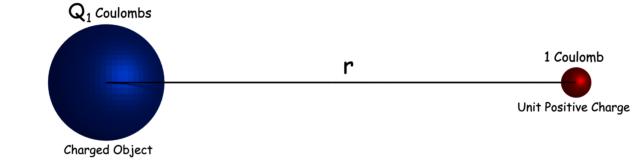
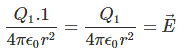
Consider a point source with charge Q1. Under Coulomb’s law, its field is determined by the source charge and distance.
The magnitude at distance r is proportional to |Q1| and inversely proportional to r squared. A positive test charge is assumed small enough that it does not alter the source-charge distribution used in the calculation. The field vector is represented by  . The symbol E denotes electric field strength or electric field intensity.
Now place an object with charge Q2 at the point where the test charge was considered.
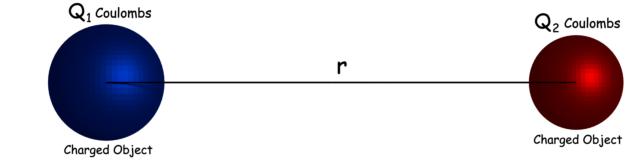
Coulomb’s law states that like charges repel and unlike charges attract. The force on Q2 is represented by  .
.

The attraction or repulsion force can be written in terms of charge and field:
The electric field vector specifies the force per unit positive charge. A positive charge experiences force along the field; a negative charge experiences force in the opposite direction.
The Direction of an Electric Field
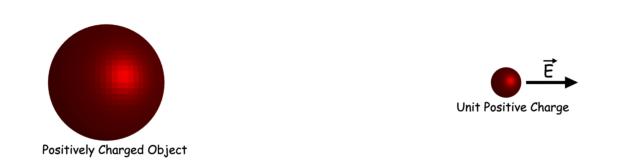
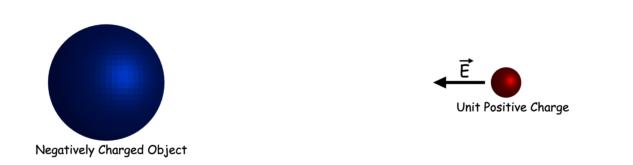
By convention, the electric field direction is the direction of the force that would act on a small positive test charge at that point.
For an isolated point charge, field vectors point away from a positive source and towards a negative source.
Because electric field has both magnitude and direction at every point, it is a vector field. Motion is not part of the definition and depends on the test particle’s initial conditions.
The Static Electric Field
Electric charge occurs with positive or negative sign. In many everyday solids, charging happens when electrons transfer between objects: an electron deficit leaves a net positive charge, while an electron surplus produces a net negative charge.
A dry comb and small pieces of paper provide a simple static-electricity demonstration. After the comb passes through dry hair several times, bringing it close to the paper can attract the pieces.
Contact and separation between the comb and hair can transfer electrons, leaving the materials with opposite net charges. The charged comb polarises each neutral paper piece, moving opposite charge slightly closer to the comb and producing a net attraction.
A charged object can therefore attract a neutral but polarisable object. Two objects with like net charges repel, while objects with opposite net charges attract. These forces arise from the electric fields produced by their charge distributions.
As a rough spatial analogy, imagine a type of glowing light bulb whose effect weakens with distance. For an isolated point charge, electric field magnitude also falls with distance, following an inverse-square relation. Light and a static electric field are different physical phenomena, so the analogy applies only to this distance dependence.
A static electric field does not vary with time. It can exert force on a charge, and the field does work when that force causes the charge to move through a potential difference.
Practical Applications of Electric Fields
Engineers calculate and control electric fields in electronics, telecommunications, insulation systems and high-voltage equipment.
Electric fields drive charge movement in the windings of induction motors, form part of the electromagnetic waves radiated by dipole antennas and determine insulation stress around electric power transmission lines.
The History of Electric Fields
The electric-field concept developed through experimental and mathematical work over several centuries. In the 19th century, Michael Faraday used lines of force to describe how electric and magnetic influences extend through space.
James Clerk Maxwell then expressed electric and magnetic relationships mathematically. The framework now called Maxwell’s equations unified electricity, magnetism and electromagnetic waves.
In the 20th century, relativity and quantum mechanics changed the description of fields and matter. The work of Albert Einstein showed that electric and magnetic fields depend on the observer’s frame of reference, while quantum theory explained how charged particles behave at atomic scales.
Recent research continues to use carefully controlled electric and electromagnetic fields in quantum devices. The linked 2023 editorial reviews silicon spin-qubit progress and cites a 2019 pulse-engineering study that reduced qubit error rates. This is one specialised example of field control in modern electronics.


