- Heisenberg Uncertainty Principle Defined: The Heisenberg Uncertainty Principle states that one cannot precisely determine both the position and momentum of a quantum particle at the same time.
- Measurement Impact: The act of measuring a quantum system disturbs it, altering the properties being measured.
- Wave Function Interaction: When an operator acts on a wave function, it collapses into a state that corresponds to the measurement made.
- Statistical Basis: Quantum mechanics uses probability distributions to predict the outcome of measurements for properties like position and momentum.
- Derivation of the Principle: The derivation of the Heisenberg Uncertainty Principle involves mathematical operators that demonstrate inherent uncertainties in quantum measurements.
What is the Heisenberg Uncertainty Principle?
The Heisenberg Uncertainty Principle says a quantum particle cannot have an arbitrarily sharp position and an arbitrarily sharp momentum at the same time. The usual statement is that the product of those spreads is at least ħ/2. That position-momentum bound is the case that appears in popular science. The same idea holds for any pair of observables whose operators do not commute, and the general form is an inequality:

Position and momentum are only one pair. This page first says what a quantum measurement does, then states the general uncertainty relation, then specialises it to Heisenberg’s position-momentum bound (those two statements are not identical).
The Heisenberg Uncertainty Principle comes from the statistics of quantum states. To use it you need to know what a measurement does to that state.
What is Measurement in Quantum Physics?
A measurement on a quantum system changes the state. Ordinary electrical measurements also load the circuit under test. That lab disturbance is not the same as the uncertainty bound, which is already present in the prepared state. You also cannot make those lab readings with zero error, but that is a separate point.
Measurement in the textbook picture applies an operator to the wave function, in line with the Schrodinger Equation.
After that operator acts, the wave function is taken to collapse to an eigenstate of the operator. The next paragraphs put that in terms of a position probability distribution.
Take the photoelectric effect as a position check: the particle leaves a slit and you try to read where it lands on the far  axis. Early quantum physics showed that particles behave like waves.
So the chance of finding the particle is not zero anywhere along that axis. The next plots are position probability densities with different spreads. If the position is only roughly known, the error (the standard deviation  ) of that distribution looks like:

If the position along that axis were known sharply, the probability density would look like:

If almost nothing is known about where the particle lands beyond the slit, the probability density would look like:

That is the statistical side of quantum mechanics. The wave function supplies a probability density for each observable you can measure, such as energy, momentum or position.
Deriving the Heisenberg Uncertainty Principle
The general uncertainty formula is not derived in full here. The first point is that a measurement is represented by an operator acting on the state vector of the system. For position that operator is (the hat marks an operator):

A position measurement therefore multiplies the state by . The momentum operator is:

That leads to incompatible observables. If the commutator of the two operators is not zero, those two quantities cannot both be sharp in the same state. The commutator of two operators is:

The general uncertainty inequality is built from that commutator. For position and momentum the commutator evaluates as:

Put that commutator into the general inequality and the last line is the usual Heisenberg (Kennard) bound. The printed middle line omits the modulus-squared of the commutator expectation; the result that is used is σ_x σ_p ≥ ħ/2:
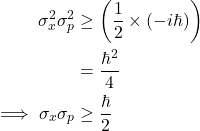
That last line is the usual form. Read it as follows: if the position of the system becomes sharp (i.e.  , the momentum spread must grow (i.e.
  and the other way round.
The momentum standard deviation has to rise as the position standard deviation falls, so the product stays at least ħ/2.
Citations
- Shankar, R. (1980). Principles of Quantum Mechanics. 1st ed. New York: Springer Science, pp.1-40.
- Gasiorowicz, S. Quantum Physics. 2nd ed. Wiley, 1996 (the page formerly cited this as 2019, Hamilton Printing, Canada).