- Natural Draft Cooling Tower Definition: A natural draft cooling tower is defined as a heat exchanger that cools water by direct contact with air, using convective flow for air circulation.
- Working Principle: It works by using sensible heat transfer and latent heat transfer to cool water and heat the air, driven by the density difference between warm inside air and cool outside air.
- Types of Towers: There are two types of natural draft cooling towers: counterflow, which has higher cooling efficiency, and crossflow, which requires less height and fewer spray nozzles.
- Applications: Commonly used in power plants, oil refineries, petrochemical plants, and natural gas plants for large-scale cooling.
- Advantages and Disadvantages: Benefits include low operational costs and high cooling capacity, while drawbacks are high initial costs and large area requirements.
A wet natural draft cooling tower is a direct-contact heat and mass exchanger. It rejects heat from circulating water to the atmosphere, mainly by evaporating a small part of the water into the air. Power stations and large process plants use these towers when the project scale justifies the tall structure. No fan drives the air. Warm, humid air inside the shell is less dense than the outside air, so it rises and draws fresh air through the tower.
How Does a Natural Draft Cooling Tower Work?
The basic process sends warm water over fill while buoyancy draws ambient air through the wetted surface. The tower can cool the water towards the ambient wet-bulb temperature, but not below it in normal evaporative operation.
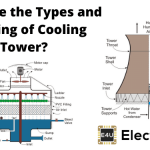
The main components of a natural draft cooling tower are:
- Hot water inlet: Warm return water enters a distribution system above the fill. Pressurised nozzles or gravity-fed basins spread the design flow across the available fill area.
- Fill material: Splash or film fill increases the water-air contact area and contact time while keeping air-side pressure loss within the natural-draft design limit. Material selection must account for water quality, temperature, fouling, fire performance and structural load.
- Cold water basin: Cooled water collects at the bottom and a pump returns it to the condenser or process. Makeup water replaces evaporation, blowdown and drift losses. Controlled blowdown limits dissolved-solids concentration, while treatment manages scale, corrosion and biological growth.
- Air inlet: Ambient air enters around the base of the shell and passes through the fill. Inlet geometry, obstructions, wind and icing can change how evenly air reaches the fill.
- Air outlet: Warm, humid air rises through the shell and leaves at the top. Drift eliminators upstream of the outlet remove entrained liquid droplets. The visible plume in cool weather is condensed water vapour, not smoke.
Water cools through sensible heat transfer and evaporative, or latent, heat transfer:
- Sensible heat transfer: Heat passes from warmer water to cooler air without a phase change. The transfer depends on local temperature difference, water and air flow rates, contact area and fill condition.
- Latent heat transfer: A small part of the circulating water evaporates into the air and carries away latent heat. The rate depends on air and water conditions, vapour-pressure difference, contact area and mass-transfer performance. Evaporation leaves dissolved minerals behind in the circulating water.
The remaining water becomes cooler and falls to the basin. The air becomes warmer and more humid, which lowers its density and strengthens the upward draft. Tower performance changes with heat load, ambient wet-bulb and dry-bulb temperatures, wind, water distribution, fill condition and pressure loss through the structure.
What are the Types of Natural Draft Cooling Towers?
Natural draft towers can use counterflow or crossflow contact arrangements:
- Counterflow natural draft cooling towers: Water moves down through the fill while air moves upward. The water distribution and drift eliminators sit above the fill, so their pressure losses form part of the draft calculation. Thermal performance depends on the complete tower design rather than flow direction alone.
- Crossflow natural draft cooling towers: Water moves downward while air crosses the fill horizontally before turning upward inside the shell. Gravity distribution basins can reduce pumping head, but the inlet and fill occupy a wider plan area. A crossflow design is not inherently less efficient; designers compare transfer performance, pressure loss, structure, maintenance and site conditions.
The practical trade-offs vary with the selected fill, water distribution and civil design:
| Type | Typical design benefits | Typical design constraints |
|---|---|---|
| Counterflow | Compact fill plan area; opposing air and water paths; enclosed distribution zone | Distribution and eliminator pressure loss above fill; pressurised spray system may need more pump head |
Crossflow – Typical benefits: gravity distribution can simplify inspection and reduce pump head. Typical constraints: the fill and air inlets need more plan area, and exposed distribution zones need weather protection. Neither arrangement is automatically cheaper, more efficient or less prone to scaling and freezing.
In counterflow, air rises against falling water. In crossflow, air enters horizontally across falling water and then turns upwards through the shell.
What are the Applications of Natural Draft Cooling Towers?
Natural draft cooling towers are candidates for sites that need:
- A large, long-term heat-rejection duty that can justify a major civil structure
- Low fan-energy use, with operation and maintenance centred on water distribution, fill, structure and water treatment
- Lower airflow noise and auxiliary power than a comparable fan-driven tower
- A design life in which structural resistance to wind loading, moisture, chemicals and corrosion is specified and maintained
Large natural draft towers are most closely associated with power generation and heavy process industries:
- Steam-cycle power stations using nuclear heat or fossil fuels, subject to local water and environmental requirements
- Large refineries with stable process-cooling loads and a suitable site
- Petrochemical complexes that operate central recirculating cooling-water systems
- Some natural-gas processing or liquefaction sites where duty, climate and layout support this tower type
What are the Advantages and Disadvantages of Natural Draft Cooling Towers?
Some of the advantages of natural draft cooling towers are:
- No large airflow fan is required, which cuts fan energy, fan maintenance and mechanical noise
- Fewer rotating airflow components can reduce mechanical maintenance, although pumps, water treatment, fill and the structure still need routine work
- They can reject large heat loads, but water loss is not fixed below 1%; evaporation varies with heat duty and range, while blowdown, drift, leaks and overflow add to makeup demand
- The tall shell can move a large air mass without fans, which suits high circulating-water flow when the tower is sized for the duty
- The high outlet helps separate exhaust air from the inlets, but wind and nearby structures can still cause plume recirculation or uneven inlet flow
Some of the disadvantages of natural draft cooling towers are:
- The shell, foundation and internals require a large initial capital investment and a long construction programme
- The tower needs a wide base, substantial height, safe plume clearance and room for water-system equipment
- Planning review may address visual impact, plume behaviour, noise, water use, drift deposition and effects on nearby receptors
- Crosswind can distort inlet flow and reduce thermal performance, especially when wind speed and direction differ from the design conditions
- Cold-weather operation needs freeze protection. Wet systems also need drift eliminators and a water-management programme to control scale, corrosion, fouling and Legionella risk.
Conclusion
A wet natural draft cooling tower rejects heat by contacting circulating water with buoyancy-driven air. Counterflow and crossflow arrangements route air through the fill differently, but either needs project-specific thermal and hydraulic design. Eliminating large fans can reduce auxiliary energy and noise at very large duties. The trade-offs include a tall structure, high capital cost, weather-sensitive performance, continuous makeup water, controlled blowdown, drift control and disciplined water treatment.